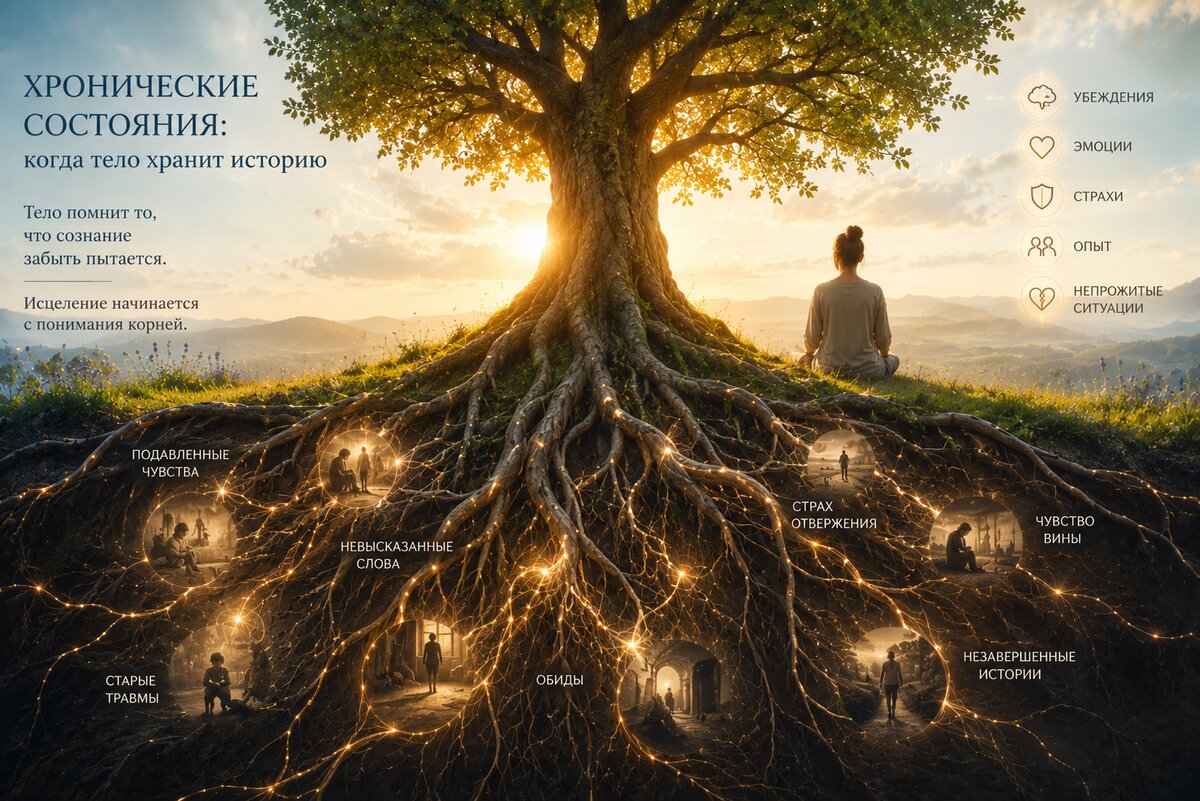
Chronic Conditions: The Body's Unfinished Story
Acute pain makes a person stop. Chronic pain makes them think.
Chronic illnesses are, more often than not, exactly what leads people to take an interest in psychosomatics and the metaphysical approach in the first place. When symptoms keep coming back despite treatment, a natural question arises: why does the body keep replaying the same scenario? The metaphysical view suggests looking for the answer not just in the illness itself, but in the inner story a person keeps living out.
Why an illness becomes chronic
From the standpoint of modern medicine, a chronic illness is a condition that persists over a long time or recurs regularly. Its development can be influenced by heredity, lifestyle, features of the immune system, past illnesses, and many other factors.
The metaphysical approach considers one more layer. If an acute symptom is often a reaction to a specific event, a chronic condition more often points to a stable inner conflict that has stayed unresolved for months or even years.
Luule Viilma repeatedly emphasized that illness is sustained not by a single emotion, but by long-held stress. As long as a person keeps living in the same emotional state, the body keeps returning, again and again, to the way of reacting it already knows.
The body remembers a state, not an event
One idea repeats across many books on psychosomatics: the body reacts not so much to a single situation as to the emotions a person lives with constantly. Not one conflict, but years of inner tension. Not one resentment, but a habit of living with resentment. Not one fear, but a constant sense that the world isn't safe.
Over time, such experiences become part of everyday life. The person stops noticing them. But the body keeps living as if the inner conflict were still ongoing.
Illness can be sustained by a life script
Liz Bourbeau's work focuses heavily on limiting beliefs and inner conflicts a person often isn't aware of. Luule Viilma talks about long-held stress. Valery Sinelnikov talks about deep subconscious programs. The wording differs, but a shared pattern runs through all these approaches: if the inner script doesn't change, the body often has to keep returning to the same symptom, again and again.
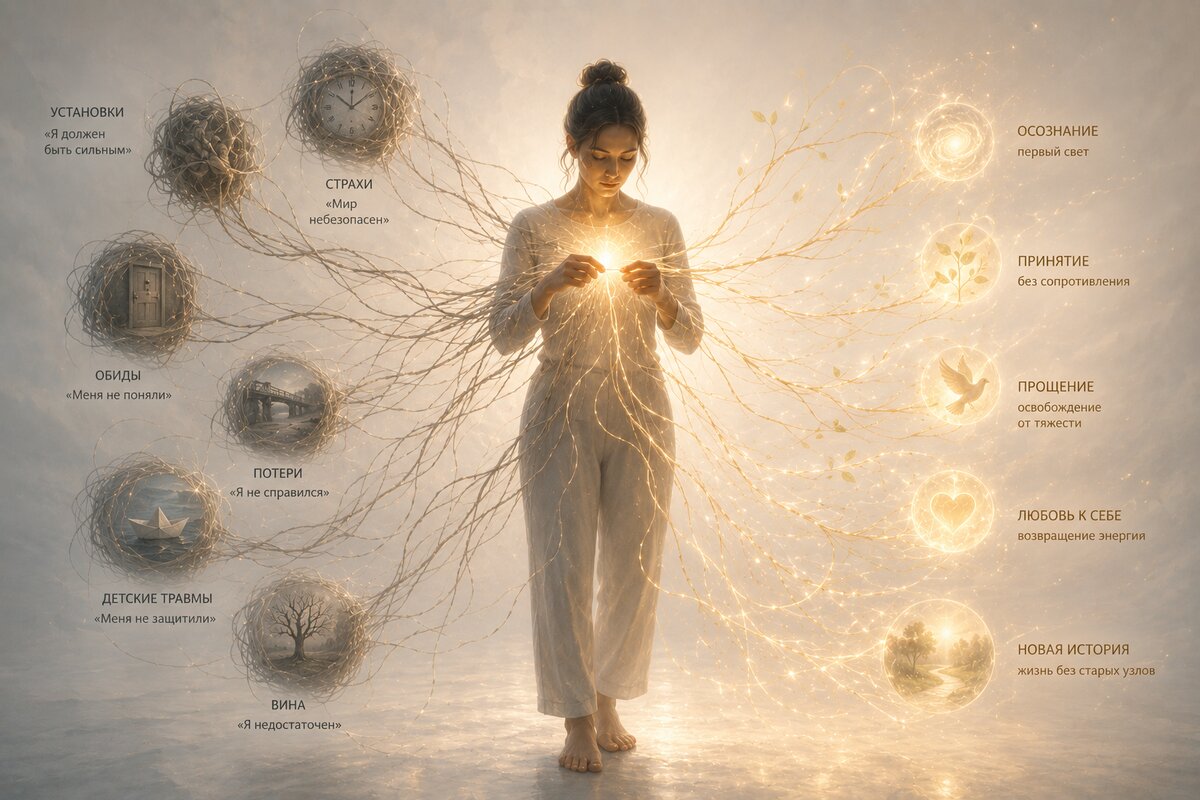
That script can take the shape of beliefs like: "I have to handle everything myself," "I'm not allowed to be weak," "love has to be earned," "I'm responsible for everyone," "if I relax, everything will fall apart." Over time, a person stops noticing these beliefs — they start to feel like a natural part of who they are.
Why the symptom comes back
This is one of the most common questions: a person goes through treatment, things improve, but after a while the illness reminds them of itself again. From a metaphysical standpoint, this can mean that the physical manifestation eased, while the inner causes sustaining the condition remained.
This doesn't take away the value of medical treatment — quite the opposite. Physical recovery and working with emotional causes can complement each other. That's why many practitioners look at chronic conditions on several levels at once — physical, emotional, and psychological.
What helps you see a chronic symptom clearly
In psychosomatics, a chronic illness isn't seen as punishment or as a mistake made by the body. It's more like a repeating signal — one that shows a certain life theme remains unresolved.
So it helps to ask yourself: when did the first symptoms appear? What was happening in my life at that time? What feelings have stayed with me for a long time? Is there a situation I keep tolerating? What beliefs guide my decisions every day? Sometimes the answers turn out to matter more than the symptom itself.
Why there are no universal explanations
You can find plenty of claims online along the lines of "if the illness is chronic, the cause is this." In practice, things are far more complex: the same diagnosis can develop in people with completely different life histories.
That's why experienced practitioners look at more than just the name of the illness. They take into account: which organ is affected, how long the illness has existed, how it's progressing, what events preceded its appearance, and which emotional states recur most often. It's the combination of these factors that reveals the individual picture.
Chronic illness is a process, not an event
The most important thing the metaphysical approach shows is that chronic illness rarely appears in a single day. Just as rarely, it disappears after a single realization. If the inner script took years to form, the body also needs time to readjust.
That's why change tends to happen gradually — through new decisions, through shifting habitual reactions, through releasing an emotional burden that went unnoticed for a long time.
You can start exploring right now
If an illness has been with you for a long time, it helps to look at it more broadly than just through a medical diagnosis. What life theme keeps recurring alongside the symptom? What changed shortly before it appeared? What feelings have become familiar?
Our analysis of metaphysical causes helps explore exactly these connections. It takes into account the nature of the illness, its location, and patterns described across various schools of psychosomatics, giving a deeper and more personalized picture than general articles or tables can offer. If, after the analysis, you'd like to work through the emotional themes you've found, the next step could be working with a specialist who uses a metaphysical or psychosomatic approach.
Instead of a conclusion
A chronic illness is more than a diagnosis. It's a story the body keeps telling, again and again. And as long as that story stays unfinished, the body may keep returning to a way of getting attention that it already knows.
Understanding that story doesn't mean giving up medical treatment. It means adding one more layer of understanding to what's happening. This is often where the path begins — not just to easing symptoms, but to deeper changes in life.