
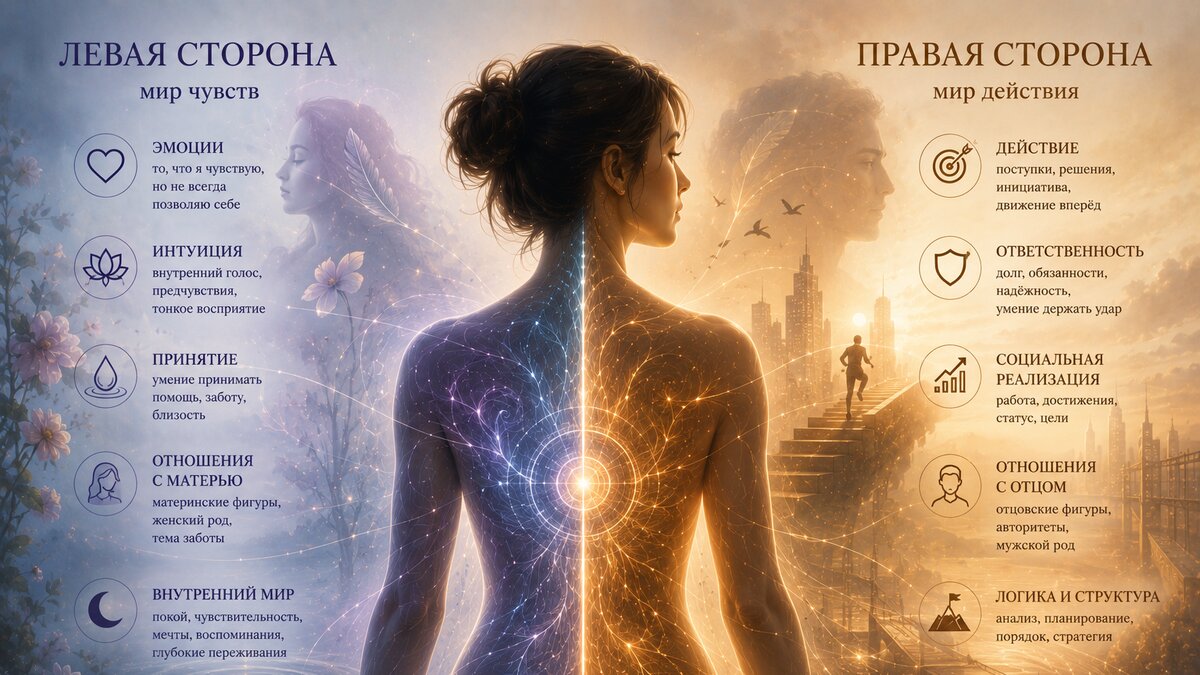
The Left and Right Sides of the Body: Why It Matters
When a person starts studying the metaphysical causes of illness, they quickly notice one detail: descriptions of symptoms often mention not just the organ itself, but also which side of the body the problem appeared on. The left shoulder. The right knee. The left eye. The right hand.
At first glance this seems like a minor detail. But in the metaphysical approach, the side of the body is considered one of the important keys to understanding an inner conflict. This doesn't mean a diagnosis can be made just from where the pain appears. However, the same problem occurring on the left or on the right can point to completely different life themes.
Why the body seems split into two stories
Almost every spiritual and philosophical tradition views the world through the principle of polarity: day and night, inhale and exhale, activity and rest, logic and intuition, receiving and giving. The human body reflects this same principle.
The metaphysical approach suggests that the left and right sides symbolize different ways of engaging with life. So where a symptom appears can point toward where to look for its emotional cause.
The right side — the world of action
The right side is traditionally associated with how a person shows up in the outer world: the realm of activity, decision-making, responsibility, action, and social achievement. Many schools of psychosomatics also link it to the masculine principle — regardless of the person's actual gender.
This isn't about men as such, but about qualities traditionally considered active: acting, achieving, protecting, taking responsibility, making plans, staying in control. So symptoms on the right side can sometimes be a reason to ask: am I trying to control everything? Have I taken on too much? Am I living only through duty?
Sometimes the right side is also linked to the relationship with one's father, authority figures, superiors, or other significant male figures. But this is only one possible direction for analysis, not a universal explanation.
The left side — the world of feeling
The left side is more often linked to a person's inner life: experiences, intuition, the ability to accept help, emotional closeness, trust. In many metaphysical schools, the left side symbolizes the feminine principle — the capacity to feel, to receive, to nurture, and to stay in touch with one's own experience.
If a symptom appears on the left, it can be a reason to ask yourself: what have I been feeling for a long time but not acknowledging? Do I find it easy to accept care? Do I allow myself to be vulnerable? Am I suppressing my emotions for the sake of others?
Sometimes such symptoms are linked to the relationship with one's mother or other important women in a person's life. But here too, this is not a ready-made answer — just one possible direction to explore.
This isn't only about men and women
One of the most common mistakes is taking this system literally. A woman can experience a conflict tied to the "masculine" theme of responsibility and control. A man can struggle with accepting care, closeness, or expressing feelings.
So the right and left sides speak less about a person's gender and more about two ways of engaging with life that exist within each of us.
What if the symptom appears on both sides?
This happens quite often too. In such cases, many practitioners suggest that the inner conflict touches both spheres at once — for example, a person may be experiencing pressure from external circumstances and inner emotional tension at the same time, or the conflict may be deep enough to affect several levels of life simultaneously. That's why bilateral symptoms are usually considered more broadly than simply the sum of the left and right meanings.
Don't look for ready-made answers
The biggest mistake in metaphysical analysis is taking the symbolism literally: a sore left shoulder means a problem with your mother, a sore right knee means a conflict at work. In real life, things are far more nuanced. Symbols only help point the search in the right direction — the real meaning always comes from the person's own history, experiences, relationships, and life circumstances.
Where to start your analysis
If you'd like to explore a symptom more deeply, try answering a few questions. Why this particular side of the body? What's happening in my life right now? Where is there more tension right now — in the outer world or inside me? Which relationships need my attention today? What feelings am I trying not to notice?
Sometimes these questions alone are enough to reveal a connection that had stayed hidden before. If you can't find it on your own, a metaphysical symptom analysis can be a useful starting point — it helps match the side of the body, the location of the problem, and life circumstances to reveal possible emotional patterns. And if you feel like going deeper, these observations can be discussed with a specialist who works with psychosomatics.
Instead of a conclusion
The left and right sides of the body aren't a map with ready-made answers. They're more like two directions in which the body invites us to begin exploring: one draws attention to how we act in the world, the other to how we feel and live through what happens inside.
And the more attentively we treat these clues, the clearer the language becomes in which our own body speaks to us.