Emotions and Organs: Why This Particular Organ Suffers
One of the main questions that comes up when getting acquainted with psychosomatics: why does one person react to stress through their stomach, another through their heart, and a third through their joints? If everyone experiences emotions, why does each body seem to speak its own language?
Finding an answer to this question is exactly what much of the work of Luule Viilma, Liz Bourbeau, Valery Sinelnikov, Rüdiger Dahlke, as well as traditional Chinese medicine and other fields studying the mind-body connection, is devoted to. Despite differences in approach, they all arrive at one shared idea: illness doesn't develop by chance, and the location of a symptom carries information too. That's why in psychosomatics, it matters not only what became ill, but where the symptom showed up.
An organ reflects a particular life theme
Every organ performs its own physiological function. But the metaphysical approach also treats it as a reflection of a particular way a person engages with life.
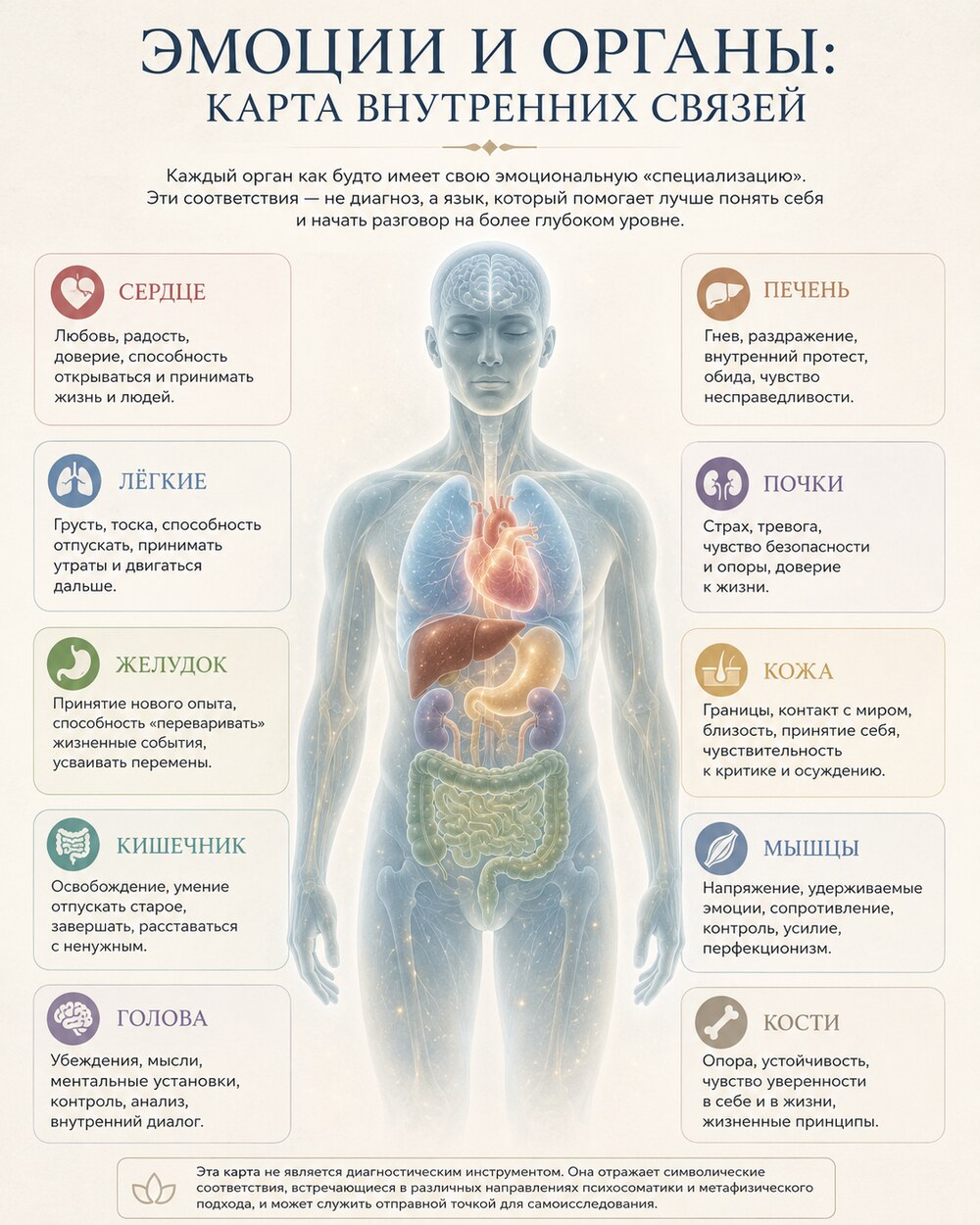
The liver is linked to inner irritation. The kidneys — to a sense of safety. The stomach — to accepting life events. The lungs — to living through loss. The skin — to personal boundaries. The heart — to love, trust, and emotional openness. These correspondences are described in detail in the work of various authors and, remarkably often, coincide independently of one another.
Illness doesn't appear at random
Of course, one can't claim there's a single emotion that causes a specific illness — every person is unique. However, years of observation show that certain emotional conflicts are reflected in certain organs far more often than others.
That's why, in metaphysical analysis, the location of a symptom matters a great deal. It helps significantly narrow down the range of possible inner causes.
Why tables alone aren't enough
You can find hundreds of psychosomatic tables online. But the same illness sometimes gets different explanations from different authors. Why? Because illness is always a combination of many factors.
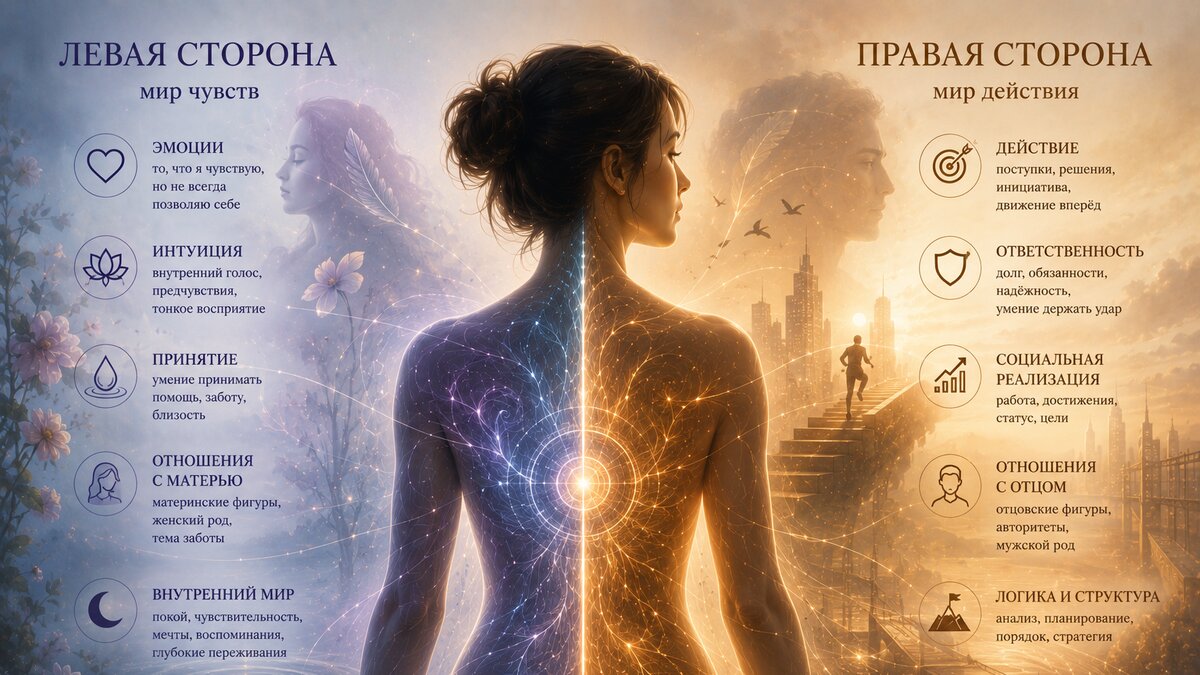
It's important to take into account: the specific diagnosis, the organ or system, the side of the body, whether it's acute or chronic, the age it first appeared, life circumstances, and recurring emotional patterns. It's the combination of these factors that brings you closer to understanding the true cause. That's why experienced practitioners never draw conclusions from the name of the illness alone.
The map is a starting point, not an answer
The infographic below shows the most common emotional themes that various schools of psychosomatics associate with the body's main organs. It helps you see the overall picture. The real answer always comes from a combination of location, the nature of the illness, life situation, and a person's individual history.
Use the map as a starting point
The emotional map of organs helps you understand which direction to look in for answers. But real exploration begins when your own experience is added to this knowledge.
This is exactly what our analysis of the metaphysical causes of illness was built for. It takes into account not just the organ or diagnosis, but additional parameters too — giving a much deeper and more individual breakdown than any universal table could.
Instead of a conclusion
The body doesn't choose where a symptom appears at random. Every organ seems to speak its own language, drawing attention to a particular side of a person's inner life. Understanding that language is one more step toward understanding yourself.